

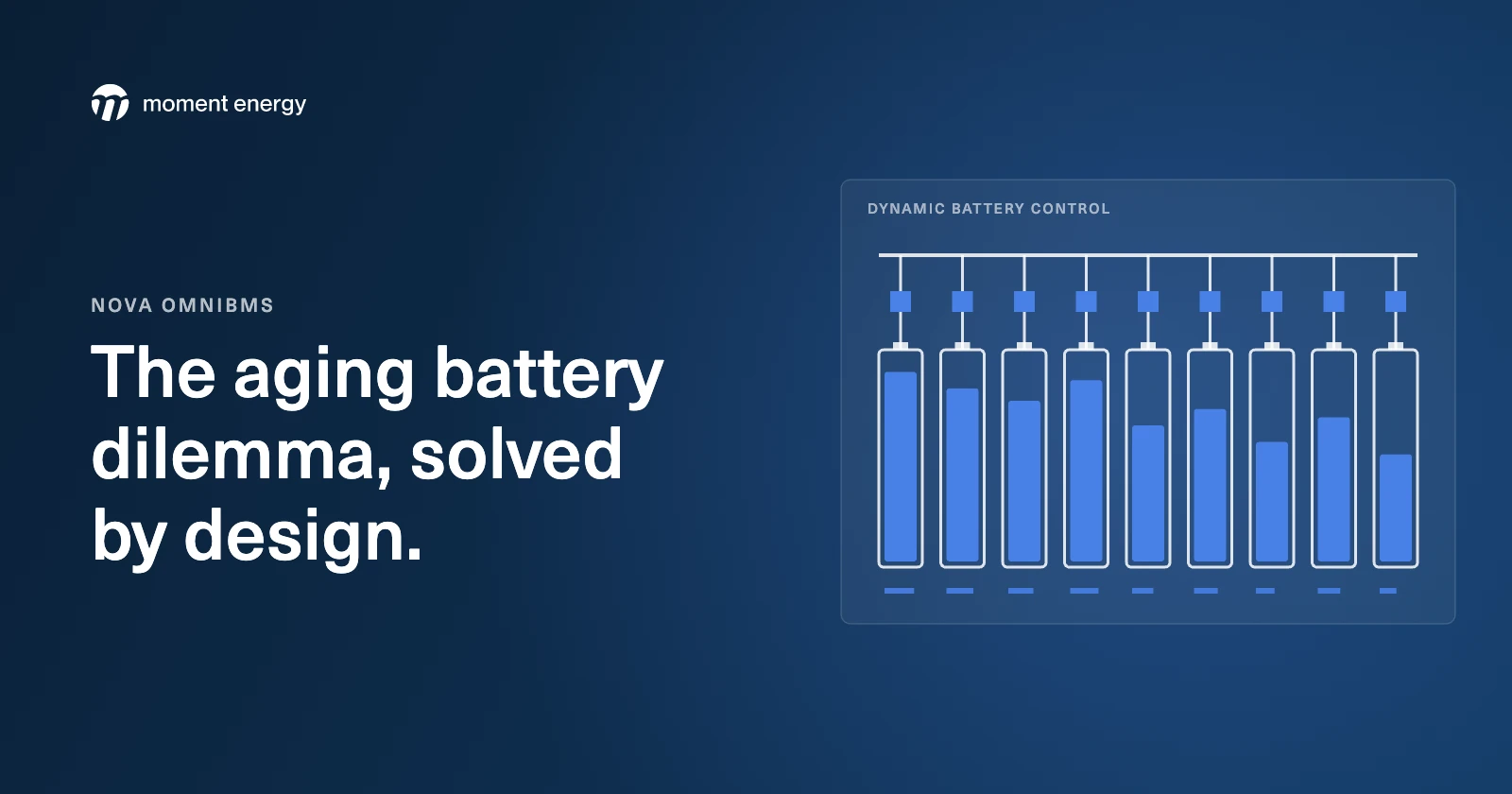
Regardless of whether a battery energy storage system (BESS) is built with imported batteries or reengineered electric vehicle (EV) batteries, every single system must pass the same core certifications in order to be permitted, insured, and financed across North America.
Certification confirms a system’s safety on the day it’s commissioned, but how do you know that system will be reliable for 5, 10, or even 20 years down the road?
The batteries inside every BESS age unevenly over time due to a variety of factors: variations in manufacturing, where they sit along the coolant path, the climate the system lives in, and more. In systems where each battery is connected directly in parallel, there’s no way to directly control how current moves between them, giving the system even less control over how each battery works together as they age.
Moment Energy’s new Nova BESS leverages three safety layers: automotive validation of every battery before it’s reengineered for stationary storage; full safety certification for its life in stationary storage applications, ensuring the system is safe to operate, insure, finance, and commission; and lastly, a battery management system (BMS) that goes above and beyond the minimum safety standards to ensure a safe, reliable system backed by a 20-year capacity guarantee.
Why there’s no avoiding the aging battery dilemma
Manufacturing variation gives each battery its own unique degradation path from the day it’s built, regardless of whether the batteries are imported or repurposed. How they’re used over their lifetimes and even where they sit within a single system impacts how the batteries degrade.
In a liquid-cooled BESS, coolant enters cold, absorbs heat as it flows along its path, and exits warmer than it started, creating a thermal gradient that leaves batteries towards the end of the path warmer than those at the very beginning.
Naturally, batteries near the end of the path end up operating at higher temperatures their entire lives, leading to greater variation in capacity over time versus batteries placed earlier in the coolant’s path. This isn’t a repurposed-battery problem; it’s a problem every BESS will face no matter what kind of batteries it’s built with.
The direct parallel connection downside
Imagine four batteries connected together side by side: the battery with the most charge would automatically balance with the battery holding the least amount of charge to naturally level out, with no way to manually control the current flowing between them.
In a standard BESS where each battery is connected directly in parallel, the current flow works similarly. As long as the batteries are evenly matched, small currents move between them and balance out. However, as the batteries age and health levels naturally diverge over time, current moves between them based on those differences, with no way for the system to measure or control it.
This issue typically starts to become apparent around 5 to 10 years into operation, well within a 20-year asset life.
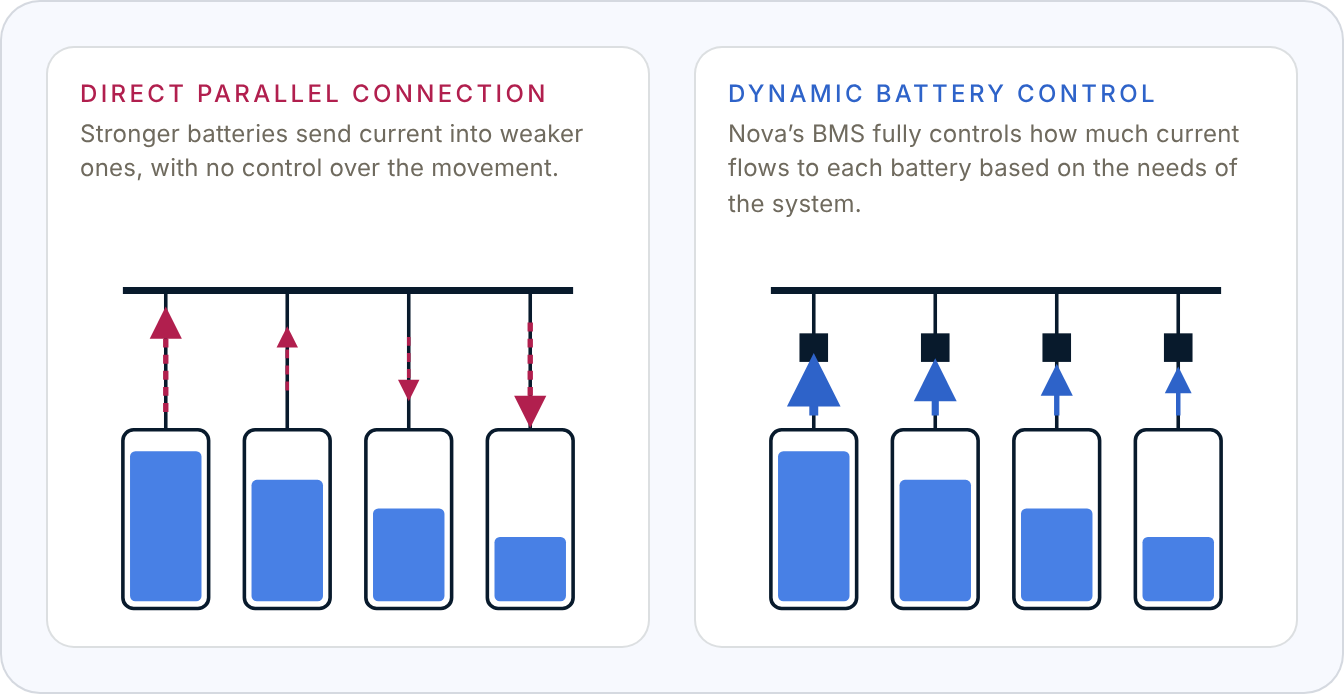
Current flow between batteries as they age: direct parallel connection compared with Dynamic Battery Control.
How Nova is engineered to solve the aging battery dilemma by design
Nova balances each of its nine batteries at two levels:
- Passive cell balancing: The industry standard, it balances the cells within each battery by releasing small amounts of excess energy as heat.
- Dynamic Battery Control: Between each battery, Dynamic Battery Control regulates how much power each battery contributes to the system.
Together, the two provide a greater level of control than what is possible in systems built with batteries wired directly in parallel. Here’s how:
Power electronics between each battery act as a valve to regulate the amount of current able to pass through. Algorithms use each battery’s state of health (SOH) and state of charge (SOC) to set its share of the load, leaning more heavily on stronger batteries while easing up on the weaker ones. The resulting impact is more control over the system as batteries naturally age over time, and an additional unique benefit: battery swappability.
What is swappability? Each battery inside Nova has its own contactors and converter, so a fault in one battery opens that battery’s contactors while allowing the other batteries to continue operating.
This means the system can be shut down temporarily, the battery replaced on site, and then the OmniBMS is able to recalibrate the system to resume operation. Because Dynamic Battery Control regulates each battery individually, a new battery can operate seamlessly alongside the original batteries inside the unit without needing to replace them all, or the whole system entirely.
In a system with batteries connected directly in parallel, even if a single battery could physically be removed and swapped out, without any way to directly control the flow of current between each individual battery, a new battery would discharge rapidly into the more aged batteries around it.
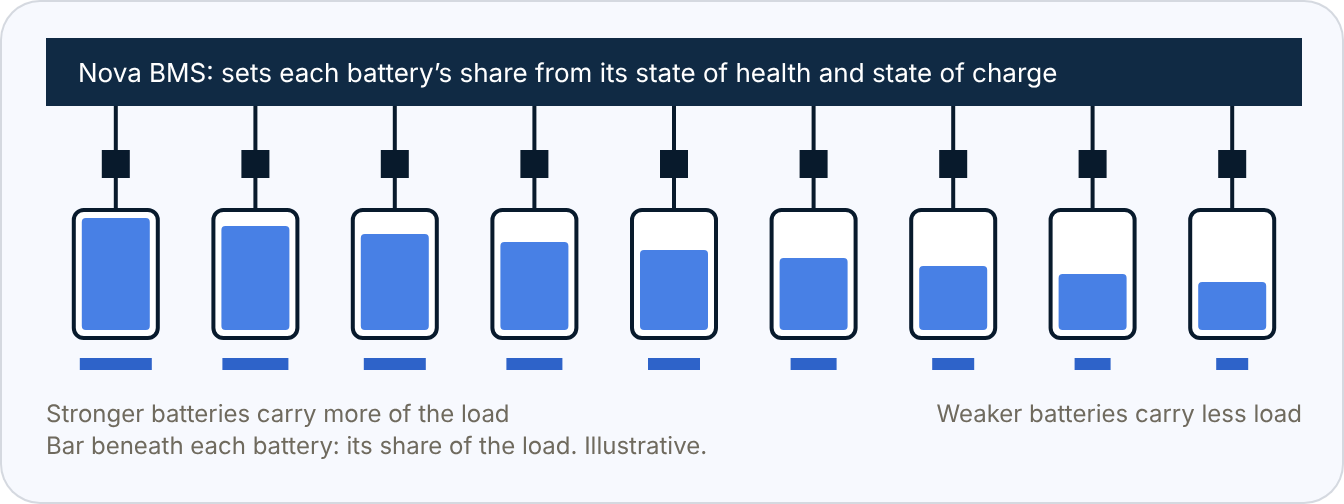
Dynamic Battery Control: per-battery current set by the BMS, compared with uncontrolled current between directly paralleled batteries.
Nova is designed for over 20 years of life, and the enclosure, cooling, power electronics, and controls are built to last. The batteries are the most variable part of any BESS, and Nova’s OmniBMS is engineered with a swappable architecture, accounting for this reality by design.
Nova’s three layers of safety, from commissioning to 20 years of operation
Moment Energy’s Nova BESS is backed by three layers of safety, starting with automotive validation. Each EV battery was engineered and validated by its original automaker to protect the people riding above it every day.
The next layer is stationary storage certification: Moment Energy screens and grades every battery that arrives at our Megafactory in accordance with UL 1974. The battery management system (BMS) and the complete Nova BESS have been tested and certified for stationary storage by UL and Intertek.
The third layer is Nova’s OmniBMS, which goes above and beyond the minimum requirements for safety certification to monitor and enhance each battery’s performance throughout the full life of the system. Beyond what typical BMSs monitor, like cell voltage, temperature, and current, Nova’s OmniBMS includes all of the control systems in the BESS, from protection of each battery to management of the full system.
Each of Nova’s nine batteries has its own contactors on both poles, fuse, insulation monitor, coolant valve, and converter for an even deeper level of integration throughout the BESS, enabling it to:
- Monitor coolant leaks, busbar voltage, and temperature: Nova’s OmniBMS can detect coolant leaks well before they become short circuits, monitors busbars to detect connections that are corroded or not torqued correctly, and goes above battery-level temperature to monitor ambient temperature inside the cabinet, making it easier to track down any overheating issues within the BESS before they become a bigger problem.
- Trigger the e-stop: Nova’s OmniBMS is certified as a safety-critical device and is natively integrated into the emergency stop loop by design, meaning it can trigger e-stops at any time as needed across the system. A BMS purchased off the shelf isn’t capable of this level of integration, and BMSs built in-house don’t always have it either.
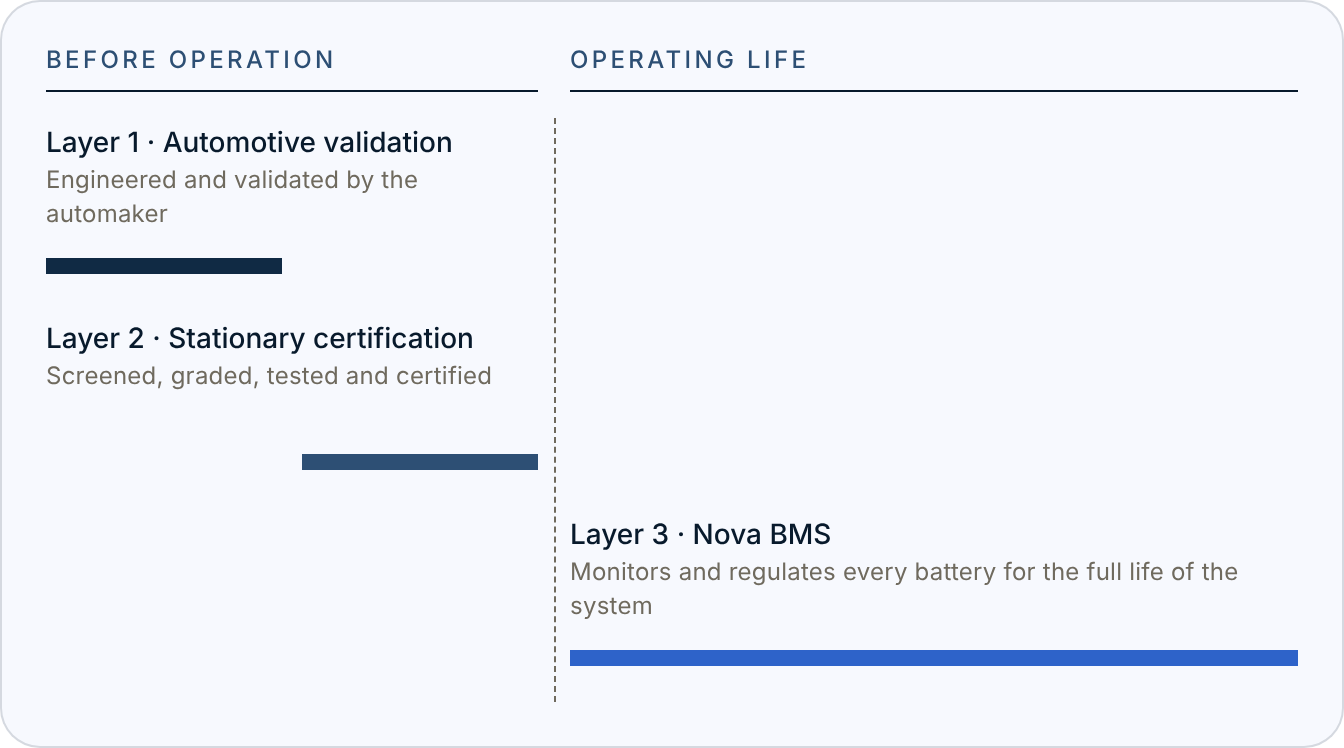
The three layers of safety across Nova’s life: layers 1 and 2 are completed before operation, while layer 3 spans the full operating life.
What this means for EPCs and their clients
Part of the job for every EPC is recommending a system and defending that choice to clients, Authorities Having Jurisdiction (AHJs), insurers, and lenders. Nova is engineered with this in mind, making it an easy choice for client projects.
Here’s why:
- Permitting & bankability: Standard UL 9540 and UL 9540A documentation for AHJ review, independent engineers, and lenders.
- Operations: Fault isolation and on-site battery swapping architecture reduce downtime and O&M costs across the lifespan of the system.
- Tax credit eligibility: Moment Energy’s non-PFE status and Nova’s full FEOC compliance are backed by independent, third-party review by a top 10 U.S. law firm, unlocking Investment Tax Credit (ITC) eligibility U.S. customers can trust.
- Cybersecurity: Moment Energy writes the BMS software in-house, and all remote updates meet UL 5500, limiting the risk of cybersecurity vulnerabilities for your clients.
Interested in learning more about Nova’s OmniBMS?
Our latest white paper, Why Long-Term BESS Reliability Rests on the Battery Management System, dives deeper into the three layers of safety behind every Nova BESS and the BMS engineered to solve for the inevitable battery aging problem every BESS faces over its lifespan.
Click here to download the white paper today.
Working on a project now? Schedule a meeting with our team or visit the product page for more information on Nova’s technical specifications.


