

March 24, 2026

Busting the 5 Biggest Myths About Second-Life EV Batteries

Gabriel Soares
Co-Founder & CTO
Millions of EV batteries retire from the road each year, with 80% to 90% of their capacity intact. It only makes sense to repurpose them into safe, certified commercial energy storage.

The technology exists. The supply is growing. The barriers are largely perception.

The Facts

Battery energy storage systems (BESS) are one of the most critical assets for increasing grid reliability. By 2030, global demand for energy storage systems will hit approximately 1.19 TWh.

Current forecasts project the supply of traditional stationary storage will only reach 634 GWh — leaving a massive deficit.

The solution is already on the road. By that same year, about 953 GWh of EV batteries will retire from their first life. That is more than enough capacity to bridge the gap.

Repurposing EV batteries keeps valuable hardware in the supply chain. Mining new materials does not offer that advantage — and it adds carbon cost that reuse avoids entirely.

Second-life EV battery performance, safety, and certification remain widely misunderstood. Moment Energy has built the world's largest data set on second-life battery degradation. The company works directly with leading regulatory bodies.

This article addresses each concern directly.

What can retired EV batteries actually do?

Engineers design EV batteries for demanding, high-stress automotive applications. When a battery is no longer fit for the road, it still holds 80% to 90% of its original capacity. That state of health makes it well-suited for stationary applications, which place far gentler demands on the cells.

Rising demand charges and an unstable grid are putting pressure on commercial operators. Stationary energy storage gives second-life EV batteries a new mission. These battery packs help reduce volatile energy costs by enabling peak shaving and critical backup power.

Repurposed EV battery storage adds at least ten years of useful life to this high-value hardware. Commercial facilities get reliable, affordable power — without the carbon cost of producing new cells.

That is the circular economy applied to energy infrastructure.
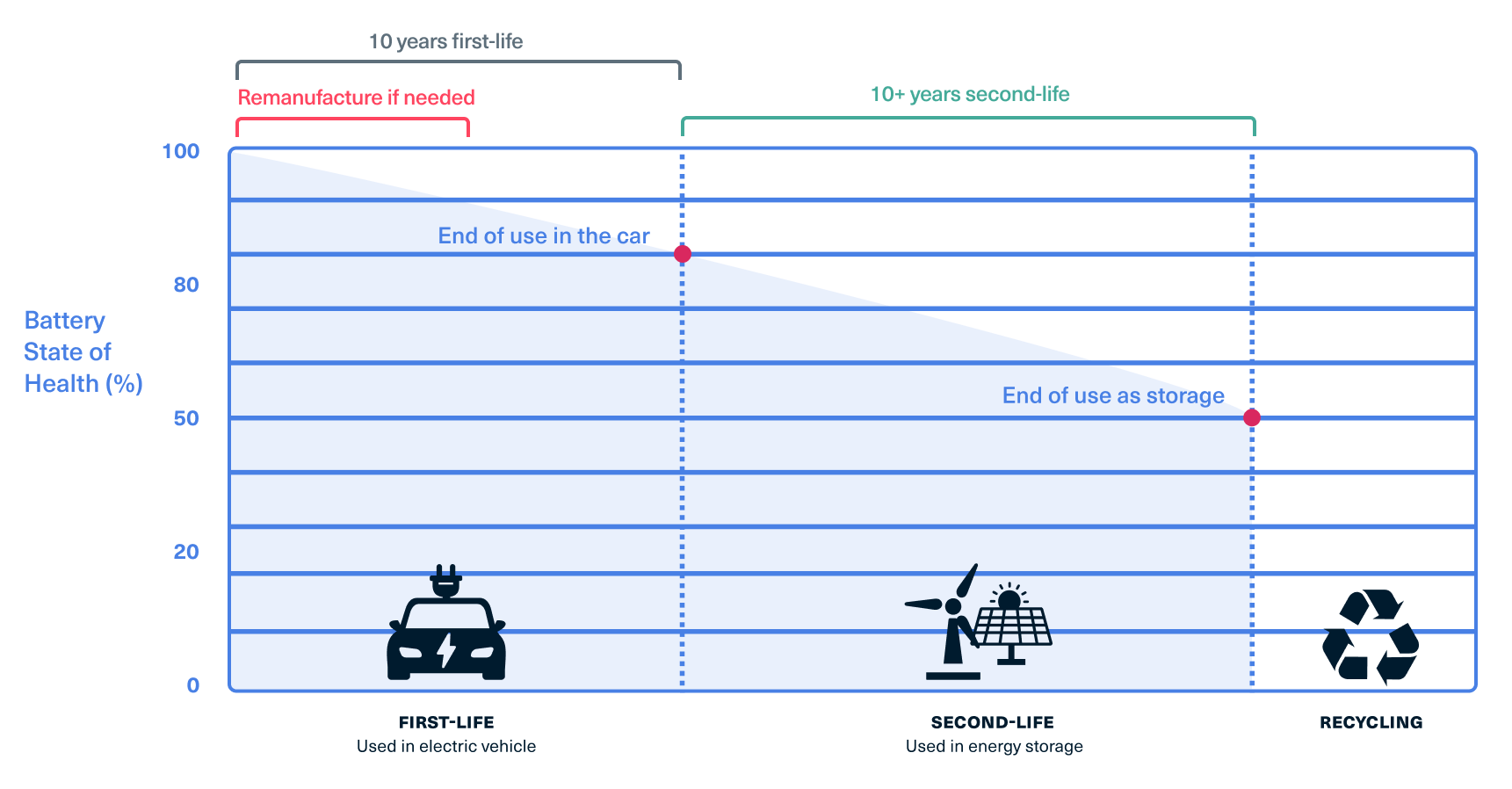
Lifecycle of an EV batteries as they go through second-life.

Are repurposed batteries safe?

Safety is the most scrutinized aspect of second-life systems, and rightly so. A well-engineered second-life system addresses thermal risk through multiple layers of protection. No single safeguard carries the load alone.

We don't need to mine our way to a reliable energy future.
Repurposing EV batteries extends their useful life by many years while delivering reliable, affordable power to commercial facilities.

Designing Multiple Layers of Battery Safety

Moment Energy's second-life battery energy storage systems layer protections so that if one fails, another responds. The battery management system, the physical enclosure, and the shutdown logic each function on their own. Together, they form one coordinated system.

Monitoring Cell Health in Real-Time
Our custom BMS uses module-level sensors to forecast thermal behaviour. The system applies cooling before it reaches any temperature threshold, preventing problems before they develop. If cooling fails, the system automatically reduces power output to limit heat. Trip logic then isolates the affected batteries the moment sensors detect an unsafe condition. Tracking state of health at this level of detail is what separates a certified system from an uncertified one.
Engineered Enclosures
The enclosure is the final layer of protection. NFPA 69-compliant pressure-venting channels hot gases safely outward. A UL-certified fire panel with multi-gas and heat sensors triggers immediate alerts under worst-case conditions. Each layer functions independently while reinforcing the performance of the others. That engineering discipline is what separates Moment Energy’s certified battery storage system from uncertified alternatives and underpins our UL 1974 certification for EV battery repurposing, ensuring safety, traceability, and consistency across second-life battery systems.

Busting the 5 Biggest Myths About Second-Life EV Batteries

Misconceptions about repurposed EV batteries persist in the market. Here are the five most common myths, and what the evidence actually shows.

Myth
Repurposed batteries are less safe than new batteries.
Fact
Most battery defects are actually found early in their first life. We source batteries that have already passed their "infant mortality "period, and our rigorous certification process then verifies their ongoing safety
Myth
This technology is too new, there isn't enough data to support it.
Fact
Moment Energy has amassed one of the world's largest data sets on second-life battery degradation. This data powers our BMS, allowing us to accurately predict performance, optimize battery life, and provide a ten year product warranty.
Myth
These systems have a high fire risk.
Fact
Our systems are designed for fire safety. The advanced BMS monitors at the cell level to detect and isolate issues instantly. This, combined with our multi-layered physical enclosure safety, is designed to contain a thermal event and protect your people and property. We conduct multiple fire tests in accordance with UL 9540A to validate system performance under worst-case conditions and ensure a robust, layered safety architecture.
Myth
Used batteries are unregulated, I can't trust them.
Fact
Our products are subjected to, and compliant with, the most rigorous safety standards in the world. We source our batteries from global automakers like Nissan and Merceds-Benz, and our industry-leading processes are foundational to the trust we've built with our clients, partners, and other industry relationships.
Myth
Repurposed batteries are lower performing and cannot support industrial energy needs.
Fact
EV batteries are among the most robust, high-performance batteries ever made, designed for extreme road conditions. Retaining 80% to 90% of their capacity, they are more than capable of meeting demanding C&I-scale applications, including peak shaving, backup power, and more.

What does this mean for commercial energy operators?

Operation and facility managers evaluating BESS manufacturers will find three clear advantages with a certified second-life energy storage provider:

  • Lower upfront cost than new lithium-ion batteries
  • A proven safety record backed by real-world degradation data
  • A meaningful reduction in embodied carbon compared to new-cell systems

The evidence supporting repurposed EV batteries is well-established. The remaining challenge is choosing the right partner. That means engineering expertise, industry certifications, and a long-term commitment to safe deployment at scale.


Key Takeaways

  • Electric vehicle batteries retain 80% to 90% of their capacity at end of road life. That makes them well-suited for stationary energy storage.
  • Rigorous certification and a custom BMS separate reliable battery energy storage systems from unverified ones.
  • Multi-layered safety engineering addresses thermal risk at every level with no single point of failure.
  • Repurposing EV batteries extends useful life by at least a decade. It supports a circular economy and reduces demand for new raw materials.
  • Moment Energy backs every deployment with a 10-year warranty, grounded in real-world degradation data.
Gabriel Soares is the Chief Technology Officer at Moment Energy, where he leads engineering and product development for battery energy storage systems powered by repurposed EV batteries. He drives the company’s technical strategy, ensuring high standards for safety, performance, and reliability while advancing scalable clean energy solutions.
LinkedIn
HQ ADDRESS

7 Burbidge St #102
Coquitlam, BC,
V3K 7B2

TELEPHONE

+1 (778) 266 9944

By using this website, you agree to the storing of cookies on your device to enhance site navigation, analyze site usage, and assist in our marketing efforts. View our Privacy Policy for more information.

Privacy Preference Center

We use cookies to enhance your browsing experience, provide essential site functions, and help us understand how you use our site. You can manage your cookie preferences at any time. Blocking some cookies may impact your experience. More information.

Accept All

Manage Consent Preferences

These items are required to enable basic website functionality.

Always active

These items help the website operator understand how its website performs, how visitors interact with the site, and whether there may be technical issues.

Thank you! Your submission has been received!
Oops! Something went wrong while submitting the form.