



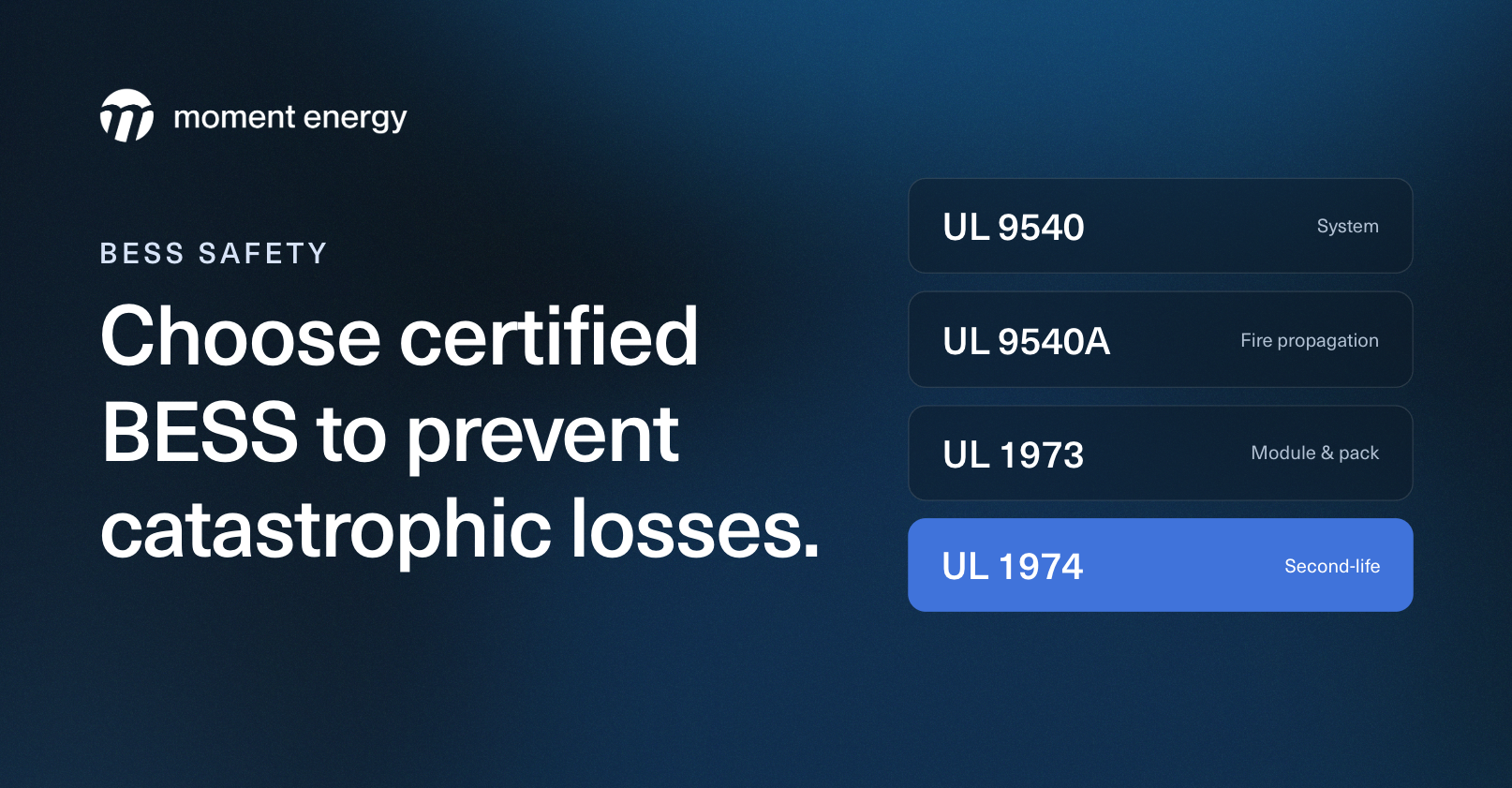
While fires in battery energy storage systems (BESS) are extremely rare, they’re also almost entirely preventable. The deciding factor? Certification: UL 9540, UL 9540A, UL 1973, and UL 1974. Whether or not a system holds certification from a nationally recognized testing laboratory versus just claiming to have been evaluated against one is the key distinction between a safe, insurable system and a massive financial liability.
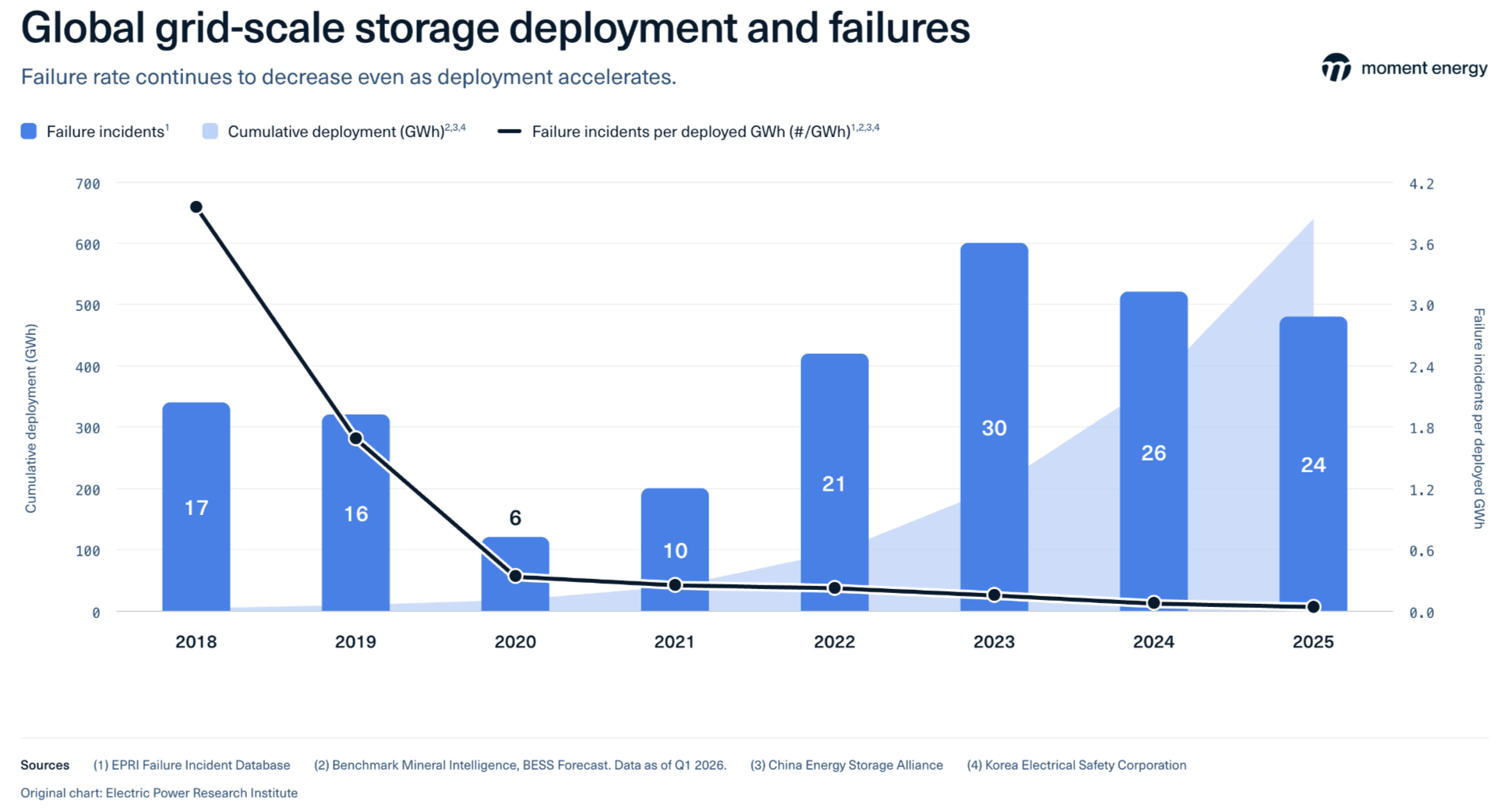
Product safety standards for battery energy storage systems have continuously improved over the years, making systems that achieve certification to these standards some of the safest products you can deploy for your energy storage project today. For example, UL 9540 has gone through three editions since its first publication in 2016, becoming more rigorous in its requirements with each. The failure incidents per deployed GWh has dropped by 98% from 2018 to 2025.
During the procurement phase of your project, you might see commercial battery storage products described as “designed to meet” or “tested to” a given certification. This language acts not as a technical distinction, but as a workaround for describing uncertified equipment without outright saying it.
The reality is: a system that is “tested to” or “designed to meet” UL 9540 has not passed it, and, for data center and commercial and industrial (C&I) customers, that gap could be the deciding factor for whether or not a facility is safe, reliable, and insurable.
Meanwhile, the cost of cutting corners in this way is very real. In January 2022, Vistra Corporation’s 300-megawatt Moss Landing Energy Storage facility experienced one of the largest battery energy storage fires in history, resulting in a reported $400M loss and the closure of the facility.
Our team reviewed the project information and found several issues with the Moss Landing system that would have prevented its deployment according to today’s certification and safety standards. For example, the system would not have passed the current level of rigorous UL 9540A thermal runaway propagation testing required today.
The good news is that preventing catastrophic losses is easier than ever before; all you have to do is ensure your equipment has the right certifications during procurement.
Look for These BESS Certifications During Procurement
BESS certification goes beyond just a single checkbox, regardless of whether or not you’re evaluating a first or second-life system for your project. Certification spans several distinct requirements:
- UL 9540: The base standard for energy storage systems and equipment, covering charging and discharging, protection, controls, and inter-device communication.
- UL 9540A: The standardized testing method for evaluating thermal runaway fire propagation, confirming a system’s safety response meets national requirements. Because this is an actual test, UL 9540A is the only item in this list that it's okay to say a system is 'tested to'.
- UL 1973: Covers module and pack-level design, construction, and safety requirements for battery modules, packs, and rack assemblies before they are integrated into a larger stationary storage system.
- UL 1974: A manufacturing certification unique to second-life systems that sets the rules for sorting, grading, and evaluating batteries so they can be safely reengineered for use in stationary storage.
A battery storage systems provider that references only one of the certifications listed above, or describes testing without naming the certifying body (i.e. UL Solutions, CSA Group, Intertek, or similar), has not demonstrated full safety certification and compliance to the highest standard.
Why Certification Matters for Data Center, C&I Customers
Battery energy storage systems are uniquely positioned to help data center customers overcome common hurdles like aging grid infrastructure and interconnection queue delays, however, choosing uncertified, uninsurable equipment negates those benefits and puts significant financial investment at risk.
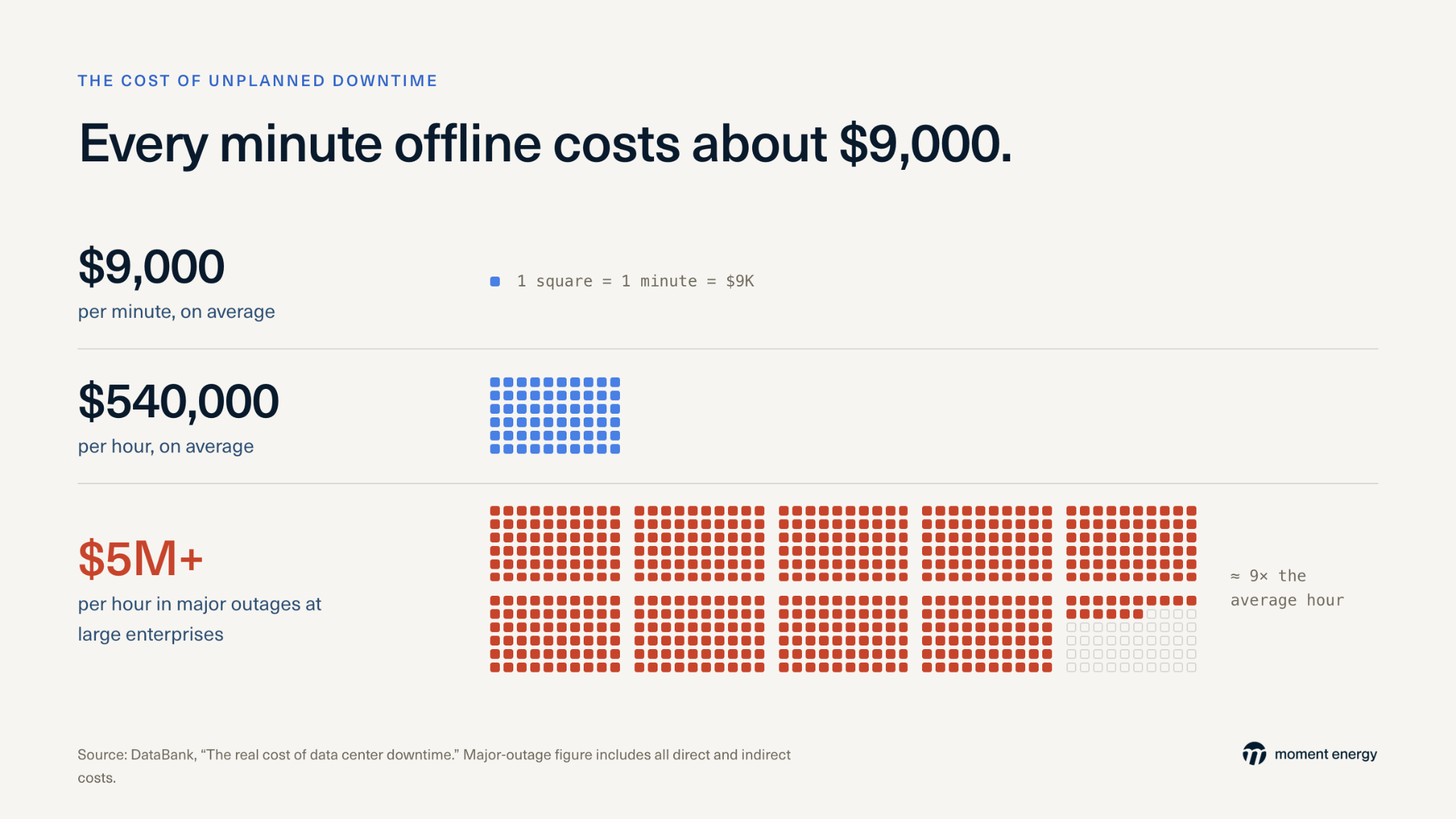
Recent industry research found the average cost of unplanned downtime has climbed to $9,000 per minute, or $540,000 per hour, with major outages exceeding $5M per hour for large enterprises when all factors are considered.
Similarly, Battery energy storage systems installed to manage peak load or provide backup power for commercial and industrial facilities are a fixed asset, often placed near production equipment by necessity due to limited space on site.
If uncertified, unpredictable equipment catches fire so close to your facility, the consequences go beyond financial damage, interrupting operations and risking costly downtime until repairs can be made.
What to Verify Before You Sign
As long as you know what you’re looking for, the distinction between “certified” and “tested to” a standard is pretty easy to check. Before signing with any second-life BESS provider, here’s what to look for:
- Verify the product listing: Ask for the product’s NRTL file or certificate number and confirm it directly on the NRTL’s certification database.
- Name the standard: Ask which specific standard each claim refers to. For example, “certified” without naming UL 9540 or UL 1974 is not an answer.
- Check the contract: Check the supplier’s contract itself for the “tested to” and “designed to meet” language. It shouldn’t appear there either.
Once you’ve verified those three key items with your supplier, you’re on the right track towards procuring a battery energy storage system you can trust.
Taking the right due diligence steps during the procurement phase of your project can save you from catastrophic financial losses and facility closures down the road. Choose certified equipment to ensure your project is safe, insurable, and built to last.
Short FAQ on BESS certification
Is UL 9540A the same as UL 9540 certification?
No. UL 9540 is a system-level energy storage safety standard, while UL 9540A is a test method focused on thermal runaway fire propagation behavior. Both can be important, but they answer different safety questions. UL 9540 requires UL 9540A testing to be completed.
Can a product be safe if it is only “designed to meet” a standard?
It may be well engineered, but the phrase alone is not enough. Without independent, third party certification or clear test documentation, buyers cannot assume the final product has been evaluated against the standard.
Why do insurers care about certification?
Insurers care because BESS failures can create high-severity losses. Certification, test reports, installation controls, and maintenance documentation help them evaluate whether the risk is understood and managed.



